







Written by: Mike Fraher on 2 August 2026, Financial Adviser (FSP1008089), Clearpath Advisory
This guide has been written by Mike Fraher on behalf of Clearpath Advisory and published on Finance.co.nz as a guest article. Clearpath Advisory is a registered Financial Advice Provider (FSP1008253) and is affiliated with Finance.co.nz. The information in this guide is general in nature and should not be relied upon as personalised financial advice. Before making financial decisions, you should seek personalised advice that takes your individual circumstances into account.
What You’ll Find in this Guide
3. How Much Deposit Do I Need?
4. Kainga Ora First Home Loan – 5% Deposit
5. Can I Use KiwiSaver For My Deposit
7. What are the Costs When Buying a Home
8. Choosing the Right Type of Mortgage
9. Making an Offer / Going Unconditional and Settling
1. About this Guide
This guide includes a short video at the beginning of each section, if you’d rather watch than read.
Buying your first home is an exciting step, but it can also feel confusing and overwhelming.
We wrote this guide to break the process down into simple, easy-to-understand steps so you know what to expect at each stage. Whether you’re just starting to save your deposit or you’re ready to buy, this guide will help you work through each step of the journey.
We’ve designed this so you can read the guide or watch the videos or both, whatever you find easiest.
Key Insights
- Don’t forget that navigating through these steps and explaining them to clients is a mortgage advisers’ job.
- It’s a complex journey where you need to work together, not just with your mortgage adviser but with other professionals too.
- You should feel comfortable with any professional adviser you engage.
2. How Much Can I Borrow?
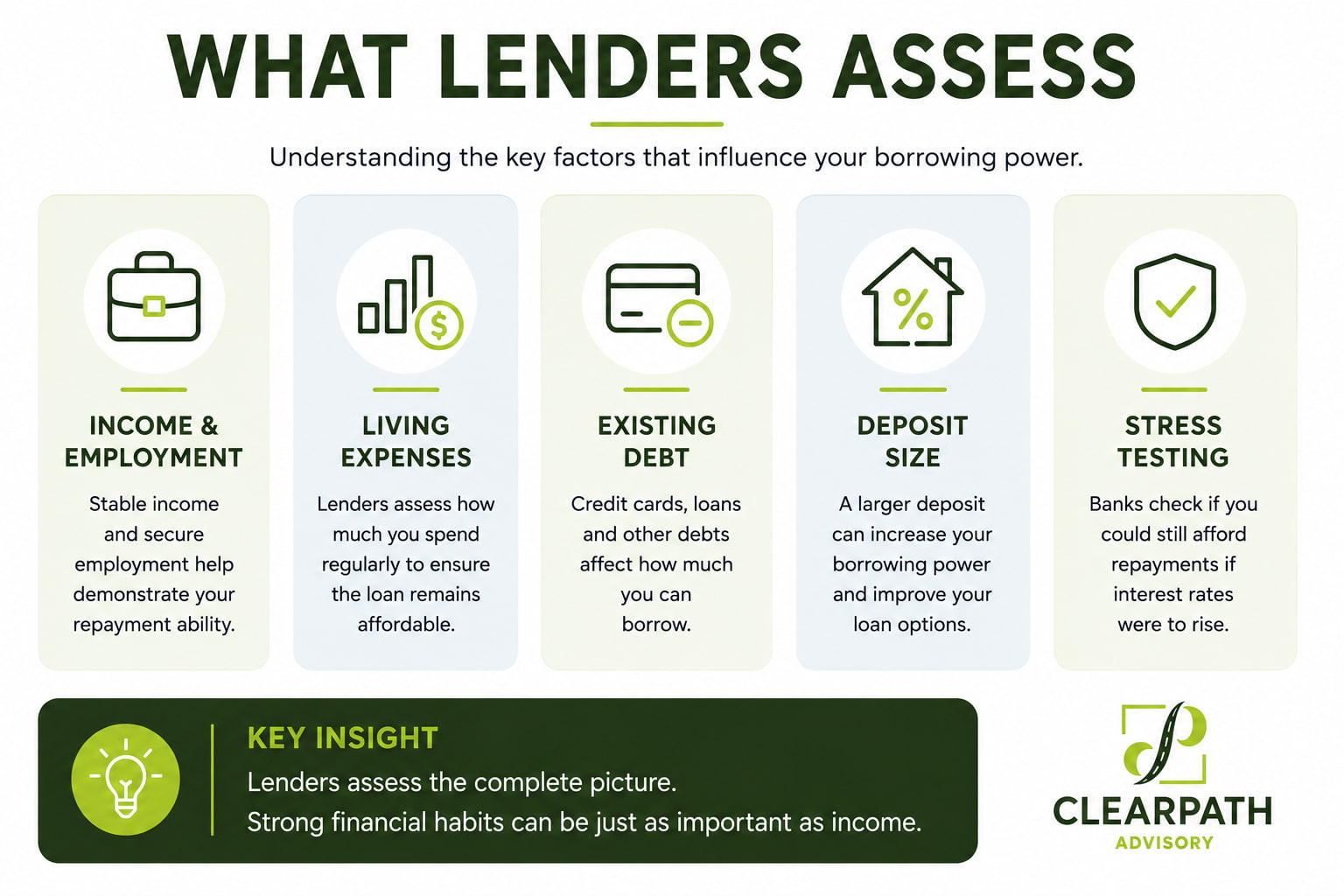
Before you start looking at properties, it’s important to understand how much you can borrow. The way you find out is by applying for a pre-approval. So it’s really helpful to know how the bank will assess your application i.e. what are they looking for?
- In a nutshell, the banks care about how much deposit you’ve saved and your ability to pay off the loan i.e. how much you earn minus how much you spend.
- Banks call this security (deposit) and servicing (amount you can afford to pay).
Key Insights
- Account Conduct and Expenses: You must have 3 months of good bank account conduct; this means no failed payments on your bank statements. Banks look at your spending habits via your bank statements to check you can pay your expenses.
- Income and Stability: Lenders like steady provable income, a salaried job with consistent history is viewed more favourably than irregular income. Self-employed buyers can get mortgages but need to show reliability of income via their financials.
- Existing Debt: When calculating your credit card debt, banks usually take your limit as opposed to your outstanding balance. They’ll also consider “Buy now pay later”, car loans and student loans. All of which will reduce the amount you can borrow.
Want to know what you could borrow?
Online calculators can provide an estimate, but lenders assess every application differently. I can review your income, deposit and existing commitments and help you understand what may be achievable.
Book to chat with Mike about your borrowing position
Or call me directly on 021 954 956
3. How Much Deposit Do I Need?
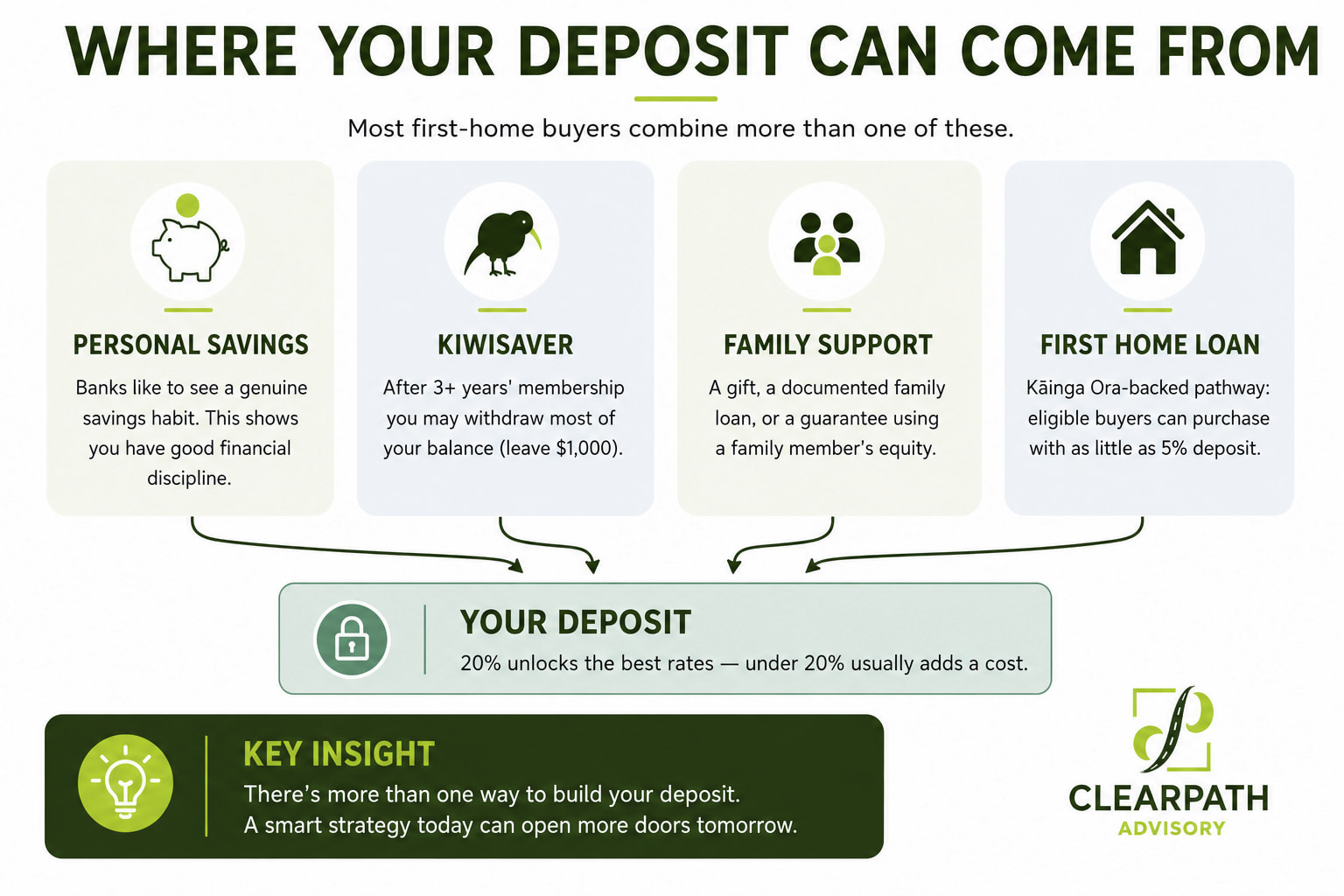
Your deposit is one of the biggest factors when getting approved for a home loan. If you’ve saved a healthy deposit that’s an indicator to the bank that you’ve learned financial discipline i.e. you can manage your finances.
20% Deposit
In New Zealand you generally need 20% deposit
- If you have a 20% deposit you get access to the best interest rates the bank offers and you have a better chance of getting approval for the amount you’re looking to borrow.
10% Deposit
Banks will lend below 20%, down to 10% depending on your financial position and ability to repay. Banks are restricted on the amount of this type of lending they can do i.e. it has to be a small part of their overall loan book.
- If you have less than a 20% deposit, you may not qualify for a lender’s special interest rates.
- Depending on the lender, you may instead pay a higher interest rate or, in some cases, a low equity margin or premium.
- It will be harder to get approved
5% Deposit
Yes, you can buy a house with 5% deposit, see our Kāinga Ora section below.
Key Insights
Low Equity Costs More
- You should have a good reason for borrowing with a 10% deposit. You’re paying a higher interest rate on a bigger amount, so there should be a good reason for you doing that as opposed to deferring the purchase until you build up to a 20% deposit.
- When you have less than 20% deposit banks require you to get a registered valuation report as part of the approval process for the loan. Your mortgage adviser must arrange this for you via a portal of approved valuers (approx. cost $800 – $1,200 for a standard house).
4. Kāinga Ora First Home Loan – 5% Deposit
Kāinga Ora is a government-owned organisation that helps eligible first home buyers purchase a home with a deposit as low as 5%. It does this by providing a guarantee to participating lenders (banks), reducing their risk and making low deposit lending possible.
- Not all lenders offer Kāinga Ora First Home Loans, and there is strict eligibility criteria set by both the lender and Kāinga Ora.
- The Kāinga Ora website provides the most up-to-date information on eligibility requirements and participating lenders.
As you are purchasing with less than 20% deposit, a registered valuation is usually required as part of the lending approval process. Your mortgage adviser will coordinate this process with the lender. The typical cost of a registered valuation is approximately $800 to $1,200.
To help cover the additional risk associated with low-deposit lending, Kāinga Ora charges a Lenders Mortgage Insurance (LMI) premium. This fee is currently 1.2% of the loan amount (as at 11/8/2026) and can usually be added to the mortgage rather than paid upfront.
Key eligibility requirements include
- You must be a New Zealand citizen, permanent resident, or resident visa holder.
- You must be buying your first home (or qualify under Kāinga Ora’s second-chance buyer criteria) and intend to live in the property.
- Your before-tax income over the previous 12 months must be no more than $95,000 for an individual or $150,000 for two or more buyers (at the time of writing – refer to the Kāinga Ora website for current limits).
- You must have a good credit history and a stable income, as the standard lending criteria still apply.
5. Can I Use My KiwiSaver For My Deposit?
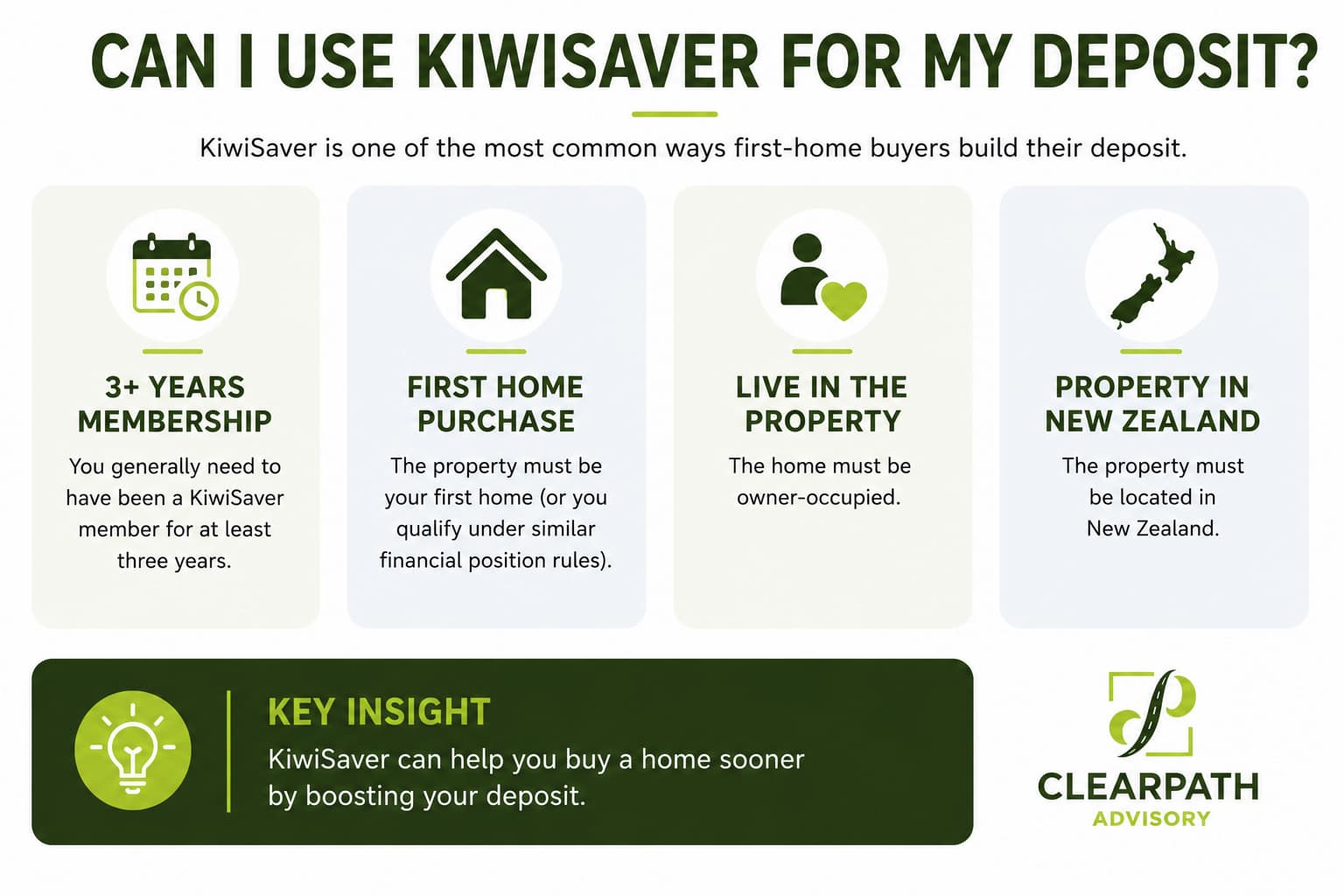
Yes, KiwiSaver is one of the most common ways first home buyers build their deposit. This is a great way to increase your deposit and get into a home earlier than you could if you had to save that money.
There’s also the great advantage that if you’re doing this in your twenties you still have a large portion of your working life to build your KiwiSaver back up again.
Key Insights
- When applying for pre-approval, your adviser may recommend obtaining a confirmation letter from your KiwiSaver provider showing your estimated withdrawal entitlement. Banks will accept this letter as proof you’re eligible to withdraw your KiwiSaver.
- Using KiwiSaver for your first home is a withdrawal not a loan, so you don’t ever pay it back.
- Once approved, your provider doesn’t pay the funds to you, they pay it directly to your solicitor’s trust account. Our solicitor applies the funds to your deposit or settlement amount.
- You cannot withdraw your entire balance; you must leave $1,000.
6. Getting Pre-Approval
What is a pre-approval?
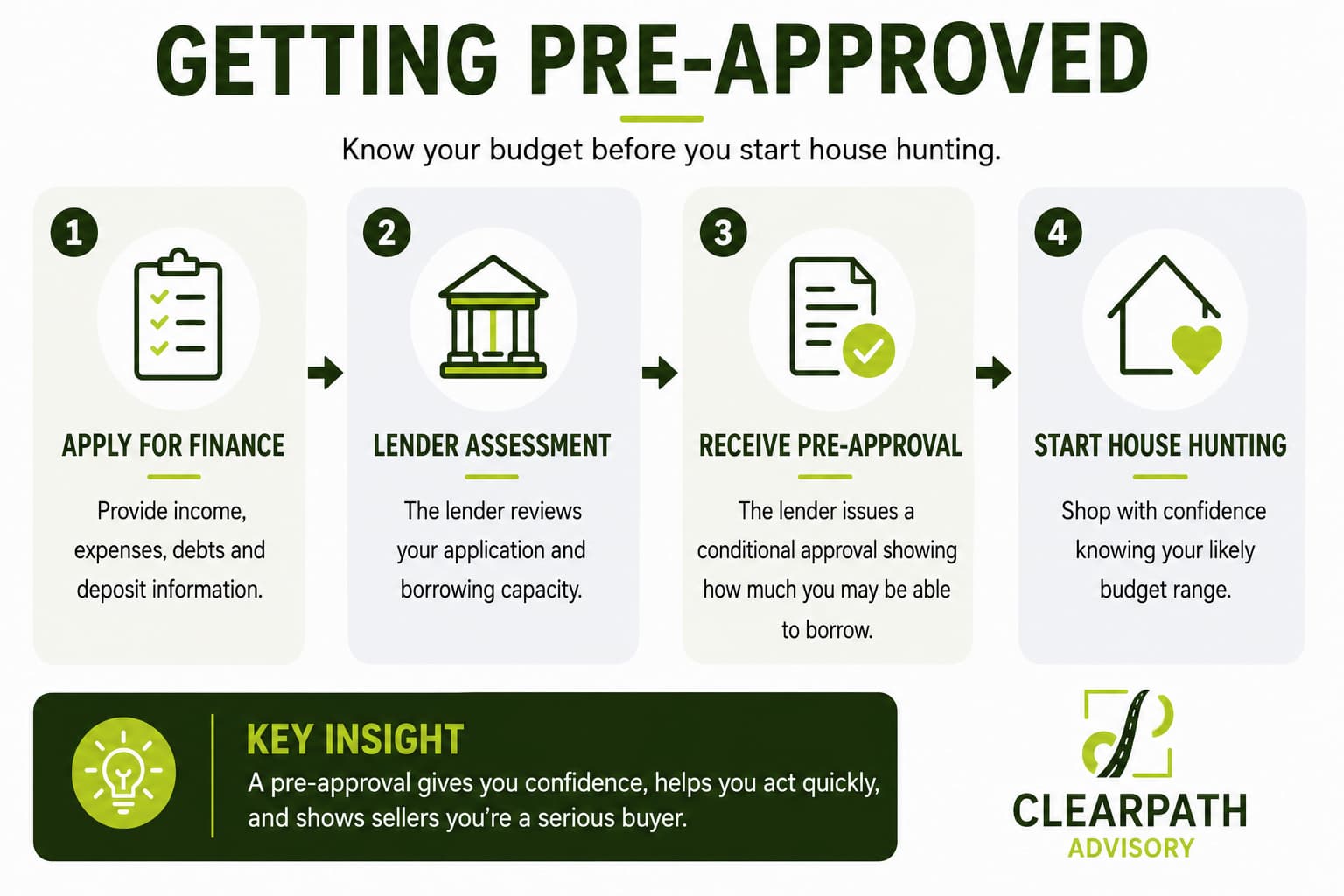
A pre-approval application is where you submit all the information normally required for a home loan application, except you haven’t yet found a property or signed a Sale and Purchase Agreement.
The bank assesses your financial situation and advises how much you may be able to borrow, providing a conditional pre-approval letter outlining the approved amount and any conditions that must be met. One of the key conditions is that the bank must approve the property you choose before confirming your loan.
Benefits of getting pre-approval
- You know your price range, so can realistically look for suitable houses
- You can move quickly when you find a property, going unconditional and settling will be faster
- Sellers and agents see you as a serious buyer. This is for good reason as you have completed the bulk of the work around applying for a loan.
- Pre-approvals typically last 60 to 90 days and can be extended.
Thinking about getting pre-approved?
I can help you understand the information lenders will require, assess your options and prepare your application for the most suitable lender.
Arrange a no-obligation first conversation
Or contact me directly:
Mike Fraher, Financial Adviser
Phone: 021 954 956
Email: [email protected]
7. What are the Costs When Buying a Home
Mortgage Adviser Cost
Most mortgage advisers are paid a commission by the lender when they arrange a mortgage and therefore do not usually charge clients directly for their services. However, every adviser must disclose how they are remunerated and whether any fees may apply.
When speaking with a mortgage adviser, it’s a good idea to ask how they are paid and whether any fees may apply. This allows you to compare advisers and choose someone who is the right fit for your needs.
Don’t be afraid to contact a mortgage adviser and ask questions. A good adviser will be happy to explain the home-buying process, answer your questions and help you understand your options.
Other Costs to Budget For
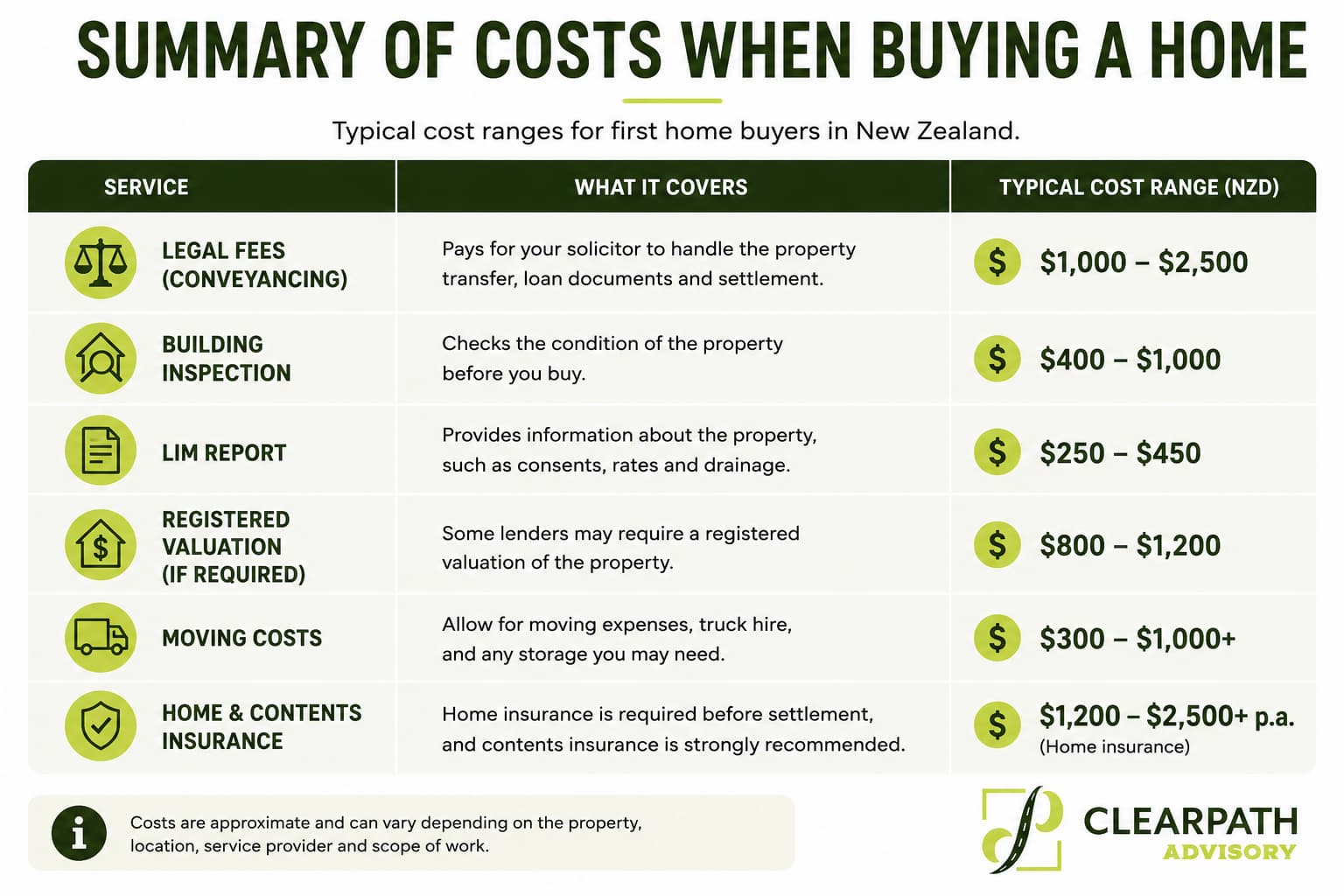
Key Insight
- Having a financial buffer for these costs can make the process smoother and reduce pressure when making important decisions.
8. Choosing the Right Type of Mortgage
This is one of the areas where your mortgage adviser can add significant value. The way you structure your mortgage can have a meaningful impact on your financial position over time.
There are many different ways to structure a home loan. A mortgage adviser’s job is to understand your financial circumstances, explain your options, and help you choose a mortgage structure that supports your goals.
Types of Mortgages
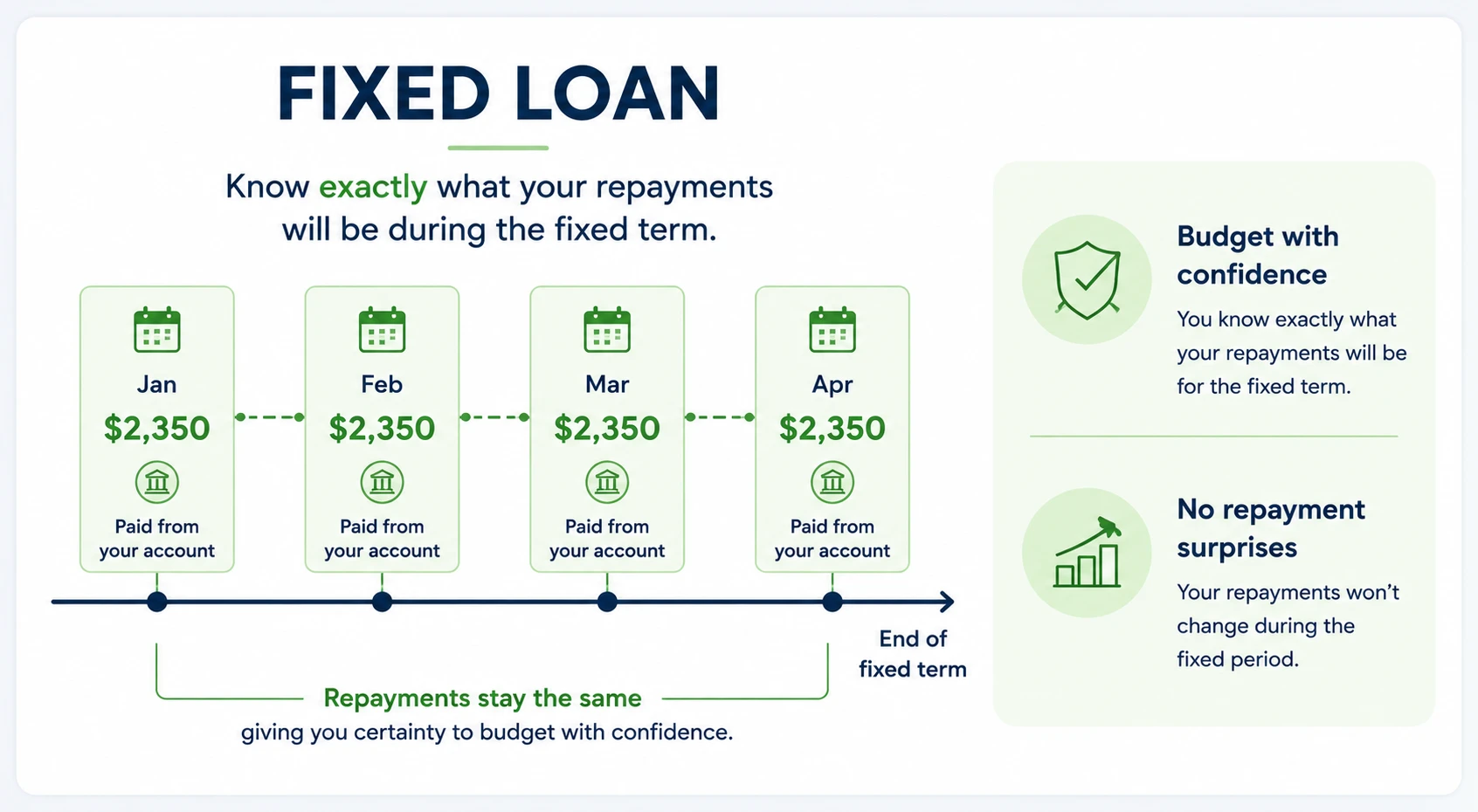
Fixed Rate Loans
Your interest rate is locked in for an agreed period (for example, 1–5 years). This provides certainty, as your repayments won’t change during the fixed term. Banks generally allow some extra payments i.e. 5% of your outstanding loan value per year is common across banks but there may be costs if you want to make extra repayments above that or repay the loan early.
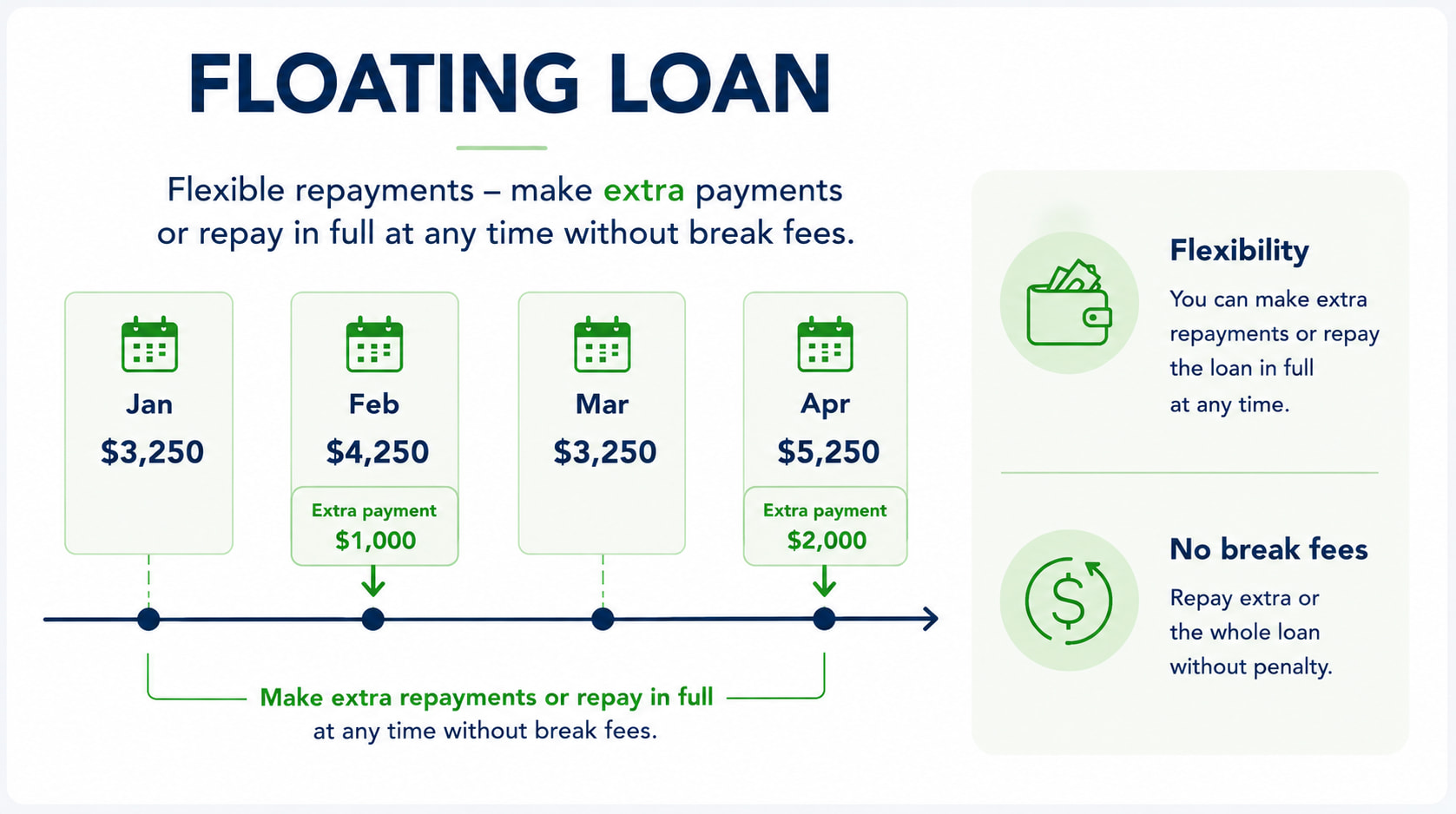
Floating Rate Loans
Your interest rate can change at any time as market rates change, meaning your repayments may increase or decrease. The main advantage is flexibility, as you can usually make extra repayments or repay the loan in full without break fees.
Split Loans
A split loan combines fixed and floating portions. This allows you to enjoy the certainty of fixed repayments on part of your mortgage while retaining the flexibility to make extra repayments on the floating portion.
Offset Mortgages
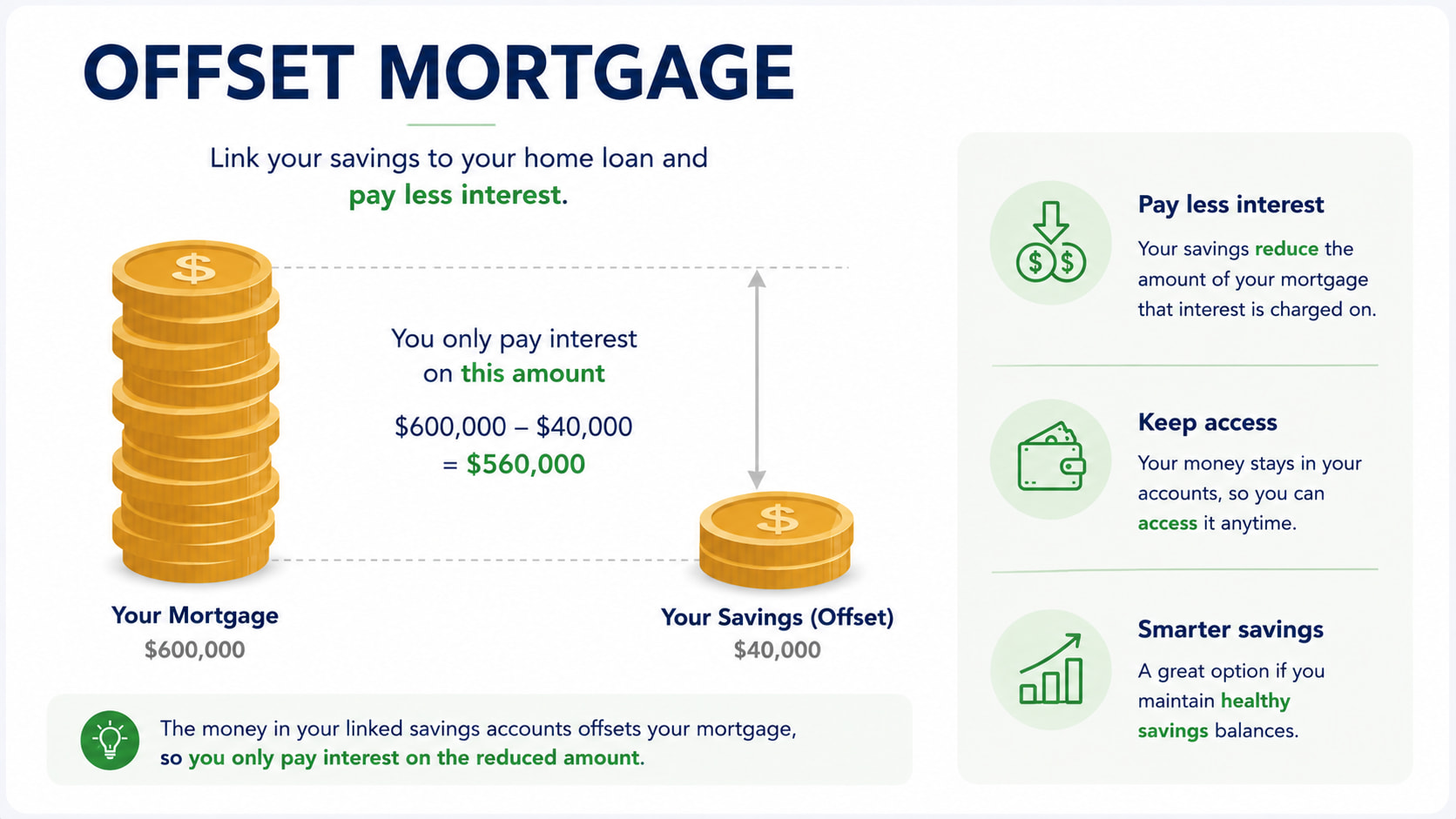
An offset mortgage links your home loan to one or more savings or transaction accounts. Instead of earning interest on your savings, the balance in those accounts reduces the amount of your mortgage that interest is charged on.
For example, if you have a $600,000 mortgage and $40,000 in linked savings accounts, you’ll only pay interest on $560,000 while that money remains in the accounts.
This can be a great option for borrowers who regularly maintain healthy savings balances while still wanting access to their money.
Note, you don’t earn interest on any of your designated offset accounts.
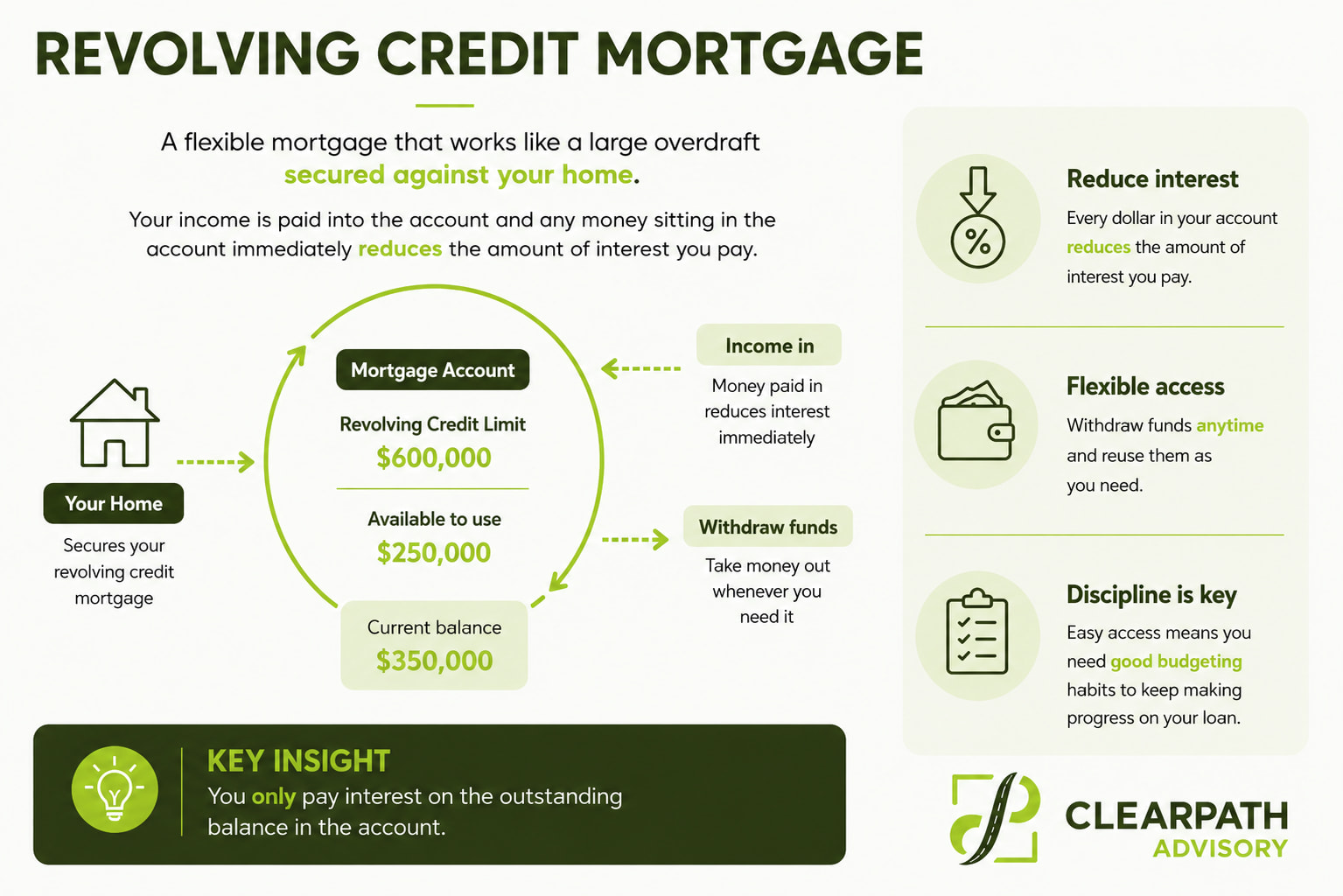
Revolving Credit Mortgages
A revolving credit mortgage works like a large overdraft secured against your home. Your income is paid into the account and any money sitting in the account immediately reduces the amount of interest you pay.
You can withdraw funds whenever you need them, making it a flexible option for people who are disciplined with their spending and expect to make extra repayments.
Because you have easy access to the available funds, this type of mortgage requires good budgeting habits to ensure you continue making progress paying down the loan.
Offset/Revolving Credit Mortgage Comment
Offset and revolving credit mortgages can help reduce the amount of interest you pay over the life of your loan. While they sound similar, they work in different ways and suit different types of borrowers. A mortgage adviser can explain the differences and help you decide whether either option is appropriate for your situation.
Key Insights
The “right” mortgage structure will depend on several factors, including:
- Your income stability and cash flow.
- Your future plans, such as renovating, upgrading, investing, or selling.
- Your comfort level with interest rate changes.
- Whether you expect to make extra repayments in the future.
There is no one-size-fits-all solution. A mortgage structure that works well for one person may not be suitable for another. This is an area where good advice can make a significant difference over the life of your loan.
9. Making an Offer / Going Unconditional and Settling
Once you’ve found a property you’d like to purchase, you’ll make an offer to the seller by signing a Sale and Purchase Agreement. The seller may accept your offer, reject it, or negotiate different terms before both parties reach an agreement.
The purchase process can then be broken into three key stages.
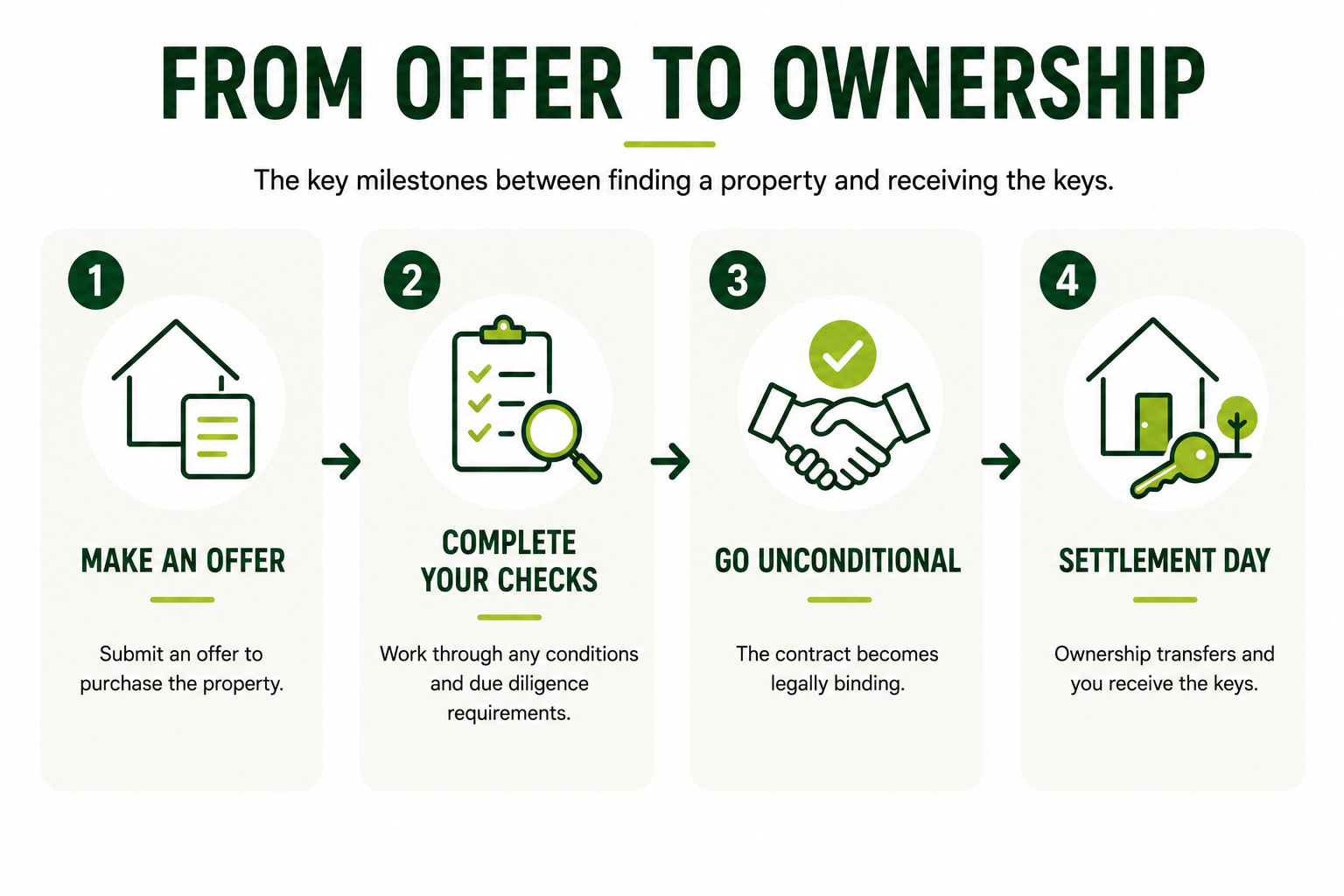
9.1. Signing the Sale and Purchase Agreement (Conditional)
In many cases, the Sale and Purchase Agreement will include conditions that must be satisfied before the agreement becomes unconditional.
Common conditions include:
- Finance approval
- Building report
- Registered Valuation
- LIM report
- EQC and insurance checks
These conditions give you time to complete your due diligence and confirm that you are comfortable proceeding with the purchase.
Typical timeframe: Around 10 working days is common for finance approval and other due diligence. If you intend to use KiwiSaver towards your deposit, allow at least 15 working days to ensure your provider has sufficient time to process the withdrawal. The exact timeframes are negotiated between the buyer and seller and recorded in the Sale and Purchase Agreement.
9.2. Going Unconditional
Once all conditions have been satisfied or waived, the agreement becomes unconditional. At this point, you are legally committed to purchasing the property, and the seller is legally committed to selling it to you.
From this point onwards, there are no remaining conditions allowing either party to withdraw from the agreement without legal consequences.
Typical timeframe: Allow at least 10 working days between going unconditional and settlement. This gives your lender and solicitor time to prepare the mortgage documentation, arrange the transfer of funds, complete the legal ownership transfer and finalise all settlement requirements.
During this period, you will usually need to:
- Confirm your final loan structure and interest rates with your mortgage adviser.
- Sign your loan documentation with your solicitor.
- Put house insurance in place and provide proof of insurance to your solicitor and lender. The bank will not release the mortgage funds until insurance has been confirmed.
- Arrange a pre-settlement inspection of the property, usually through the real estate agent, to confirm the property is in the agreed condition before settlement.
9.3. Settlement Day
Settlement day is the day ownership of the property transfers to you.
On settlement day:
- Your lender releases the mortgage funds.
- Your solicitor transfers the purchase funds to the seller’s solicitor.
- Ownership is transferred into your name.
- You receive the keys to your new home.
Key Insight
- Many buyers think settlement day is the most important milestone. In reality, the biggest commitment occurs when the agreement goes unconditional, because this is the point at which both the buyer and seller become legally committed to completing the transaction.
10. Wrapping It All Together
As you’ve seen throughout this guide, buying your first home is a journey with a number of different steps and professionals involved. It can sometimes feel overwhelming, but guiding clients through this process is exactly what a mortgage adviser does.
That’s where our Property Purchase Tracker can help. It provides a simple step-by-step checklist, so you’ll always know where you are in the buying process, what’s coming next, and who is responsible for each stage. Every one of our clients receives a copy, giving them confidence that they know exactly what happens next.
Ready to take the next step?
If you’re thinking about buying your first home, I’d be happy to talk through your situation and help you understand your next steps.
There’s no charge and no obligation to have a chat. We’ll discuss your deposit, income and plans, and determine how I may be able to help.
Or contact me directly:
Mike Fraher, Financial Adviser
Phone: 021 954 956
Email: [email protected]
I look forward to helping you take the first step towards owning your own home.